 Stonk
StonkBuilder / Blog
Clear guides for a noisy market.
Plain-language explainers on crypto mechanics, memecoin launches, Solana tokens, and reading on-chain evidence — with visuals, not hype.
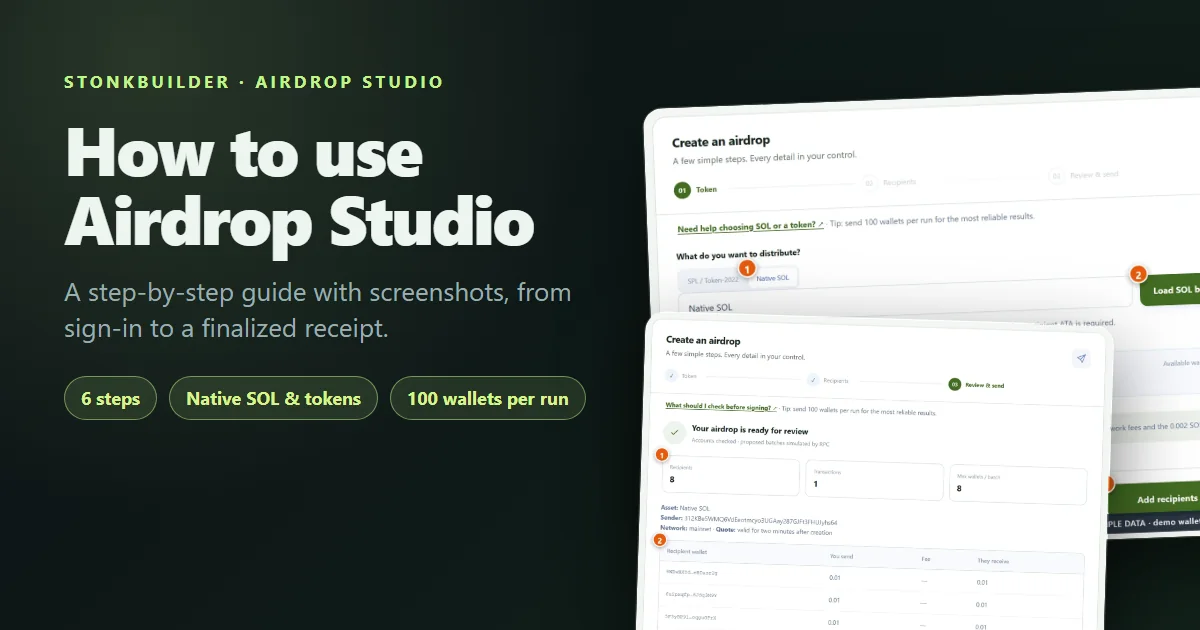
How to Use Airdrop Studio: A Step-by-Step Guide
Send SOL or tokens to many wallets with Airdrop Studio: sign in, connect your wallet, load your asset, add recipients, review the costs and send, with 100 wallets per run for reliable results.
How to Join a StonkBuilder Community: Account, Membership, and Contributions
Create and verify a member account, explicitly join a public StonkBuilder community, use the member portal, and understand contribution review and points.
Create a StonkBuilder Community: Setup, Preview, and Publish
Set up a StonkBuilder community profile, choose a public handle and template, verify your email, preview the page, publish, and manage member tools.

What Does “Source Reviewed” Mean on a Community Link?
Learn how creator self-checks, independent source reviews, and link-health checks differ—and what a reviewed community link does not prove.
Why On-Chain Data Can Be Incomplete
Public blockchains are transparent, but a report built from them can still be incomplete. Coverage depends on network, RPC, indexer, token program,...
Why Global Finance Needs Blockchain
Cross-border payments still cost 6% and take days. What a shared ledger, stablecoins, and programmable settlement actually fix, what they don't, and who is already using them.
What Is StonkScope? Reading Evidence-Aware Crypto Analytics
StonkScope was the read-only wallet reward tracker of the StonkBuilder ecosystem. It was retired in October 2026; its lessons on reading reports still apply.
What Is StonkBuilder? A Clear Guide to the Product
StonkBuilder is a crypto-focused product and content ecosystem for people who want clearer project websites, launch communication, and evidence-aware...
What Is Slippage in Crypto? Price Impact and Execution Explained
Slippage is the difference between an expected trade price and the price actually executed. It can come from market movement, shallow liquidity,...

What Is On-Chain Analytics? A Practical Guide to Blockchain Data
On-chain analytics organizes and interprets public records such as transactions, balances, program calls, and timestamps. It can reveal observable...
What Is a Stablecoin? USDC, Payments, and Key Risks
A stablecoin is a crypto token designed to track a reference value, often a fiat currency such as the US dollar. The design, reserve model, issuer,...
What Is a Memecoin? A Clear Beginner's Guide
A memecoin is a crypto token whose identity is strongly connected to a meme, character, cultural reference, or online community. It may be created for...
What Is a Link in Bio? A Creator's Practical Guide
A plain-language guide to link-in-bio pages, what they are for, and how to make one useful.
What Is a DEX and How Does It Work?
A decentralized exchange, or DEX, lets users trade through on-chain programs rather than a traditional centralized order desk. It may use pools,...
What Is a Crypto Wallet? Public Addresses and Keys Explained
A crypto wallet helps a person manage keys and authorize transactions; it does not literally store coins in a folder. The blockchain records balances...
What Does “Stonk” Mean? Internet Culture and Crypto Context
“Stonk” is an internet-culture spelling associated with exaggerated or humorous conversations about markets and investing. In the StonkBuilder...
What Is Solana Token-2022? Extensions and Review Questions
Token-2022 is a Solana token program that supports extensions for selected token behaviors. Extensions can be useful, but create configuration and...
Stonk vs Meme Stock: Similar Name, Different Context
“Stonk” is internet slang used playfully for a stock or asset, while “meme stock” usually describes an equity influenced by online communities....
Stablecoin vs Bank Transfer: Comparing the Full Payment Journey
Stablecoin and bank transfers are different payment journeys with different custody, finality, fees, privacy, and dispute controls. A useful comparison...
How to Organize Official Links for a Solana Project
Keep Solana project documentation, social channels, and community destinations clear and easy to verify.
On-Chain Rewards vs Ordinary Token Transfers
A token transfer records movement between addresses; a reward is a label applied when a project or program says the movement compensates participation....
How to Build a Useful Home for Your Online Community
Design a community front door that explains the group, answers first questions, and gives members a clear next step.
Memecoin Red Flags: How to Review a New Token Carefully
A memecoin review should begin with evidence, not excitement. Check the official mint, token program, supply, authorities, allocation, liquidity, team...
Memecoin Marketing Without Spam or Misleading Claims
Responsible memecoin marketing makes a project easier to understand instead of manufacturing urgency. Publish stable facts, explain purpose and...
Market Cap vs Liquidity in Crypto: Why Both Matter
Market capitalization usually combines a token price with a supply measure. Liquidity is the market’s capacity to absorb trades without large price...
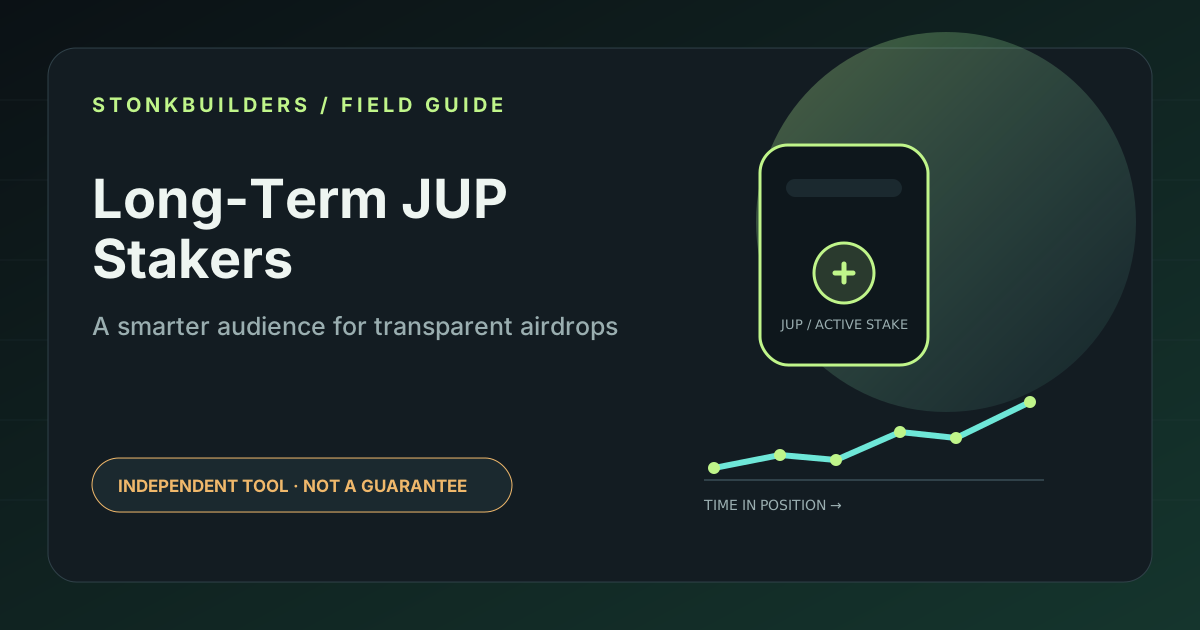
Long-Term JUP Stakers: A Smarter Airdrop Audience
Use the JUP Staker Scanner to find long-term JUP stakers through balance and duration signals for evidence-aware community drops.
Link-in-Bio Page or Personal Website: What Do You Need?
Compare a link-in-bio page with a personal website and choose the simplest format that fits your next goal.
Link Clicks, Visits, and Conversions: A Creator's Measurement Guide
Learn what page visits and link clicks can tell you, what they cannot prove, and how to improve a creator page responsibly.
Link-in-Bio Examples for Creators and Community Builders
See the building blocks behind useful link-in-bio pages for creators, projects, and online communities.
Jupiter vs Raydium: Aggregation, Swaps, and Liquidity
Jupiter and Raydium are different layers in Solana trading. Jupiter presents routing and trading products that can compare venues, while Raydium...
Jupiter Swap Failed or No Routes Found? What to Check
A Jupiter swap can fail because a route is unavailable, liquidity is insufficient, the trade size is unsuitable, the token has restrictions, the quote...
Jupiter Global vs Jupiter Exchange: Which Does What?
Jupiter Global and Jupiter Exchange answer different user questions. Jupiter Exchange is the research path for Solana swaps and trading quotes; Jupiter...
Jupiter Global Supported Countries: Check Each Feature
There is no single useful answer to “Jupiter Global supported countries” unless the feature is named. Residence verification, account opening, card...
Jupiter Global Fees and Limits: Card, FX, and Transfers
Jupiter Global fees and limits depend on the feature: funding, foreign exchange, card spending, QR payments, account transfers, and withdrawals can...
Jupiter Global Card and QR Payments: What to Check Before Paying
Jupiter Global card and QR payments combine an onchain account with a real-world merchant journey. Before paying, confirm merchant acceptance,...
Jupiter Exchange Fees Explained: Reading the Full Quote
Jupiter Exchange fees are best understood by reading the complete quote rather than searching for one universal percentage. A swap can involve network...
JUP Staking Explained: Governance, Unstaking, and Eligibility
JUP staking questions should be separated into token custody, governance rules, current product mechanics, and any campaign eligibility claim. Holding...

How to Write a Creator Bio That Tells People What to Do Next
Write a short creator bio that gives visitors context and points them toward a useful next action.
How to Use Jupiter Global: Verification, Funding, and Payments
The documented Jupiter Global journey is to download the app, complete verification, fund an account, and then use the supported card, account, QR, or...
How to Use Jupiter Exchange: A First-Swap Walkthrough
To use Jupiter Exchange responsibly, verify the official interface, choose the exact input and output assets, inspect the quote, and review the wallet...
How to Research a Crypto Project: An Evidence Checklist
Researching a crypto project means identifying the exact product, network, people, permissions, and evidence behind its claims. Start with a question...
How to Read a Community Leaderboard
Learn how a community leaderboard is scoped, what its points show, and which details to check before interpreting a creator's rank.
How to Read an On-Chain Rewards Report
Start by checking the report scope: wallet address, time range, data providers, finality, and coverage status. A report that says “observed” is not...
How to Organize Your Link-in-Bio Page
A practical way to choose link order, labels, and sections that make a creator page easier to use.
How to Launch a Memecoin: A Responsible Step-by-Step Guide
Launching a memecoin is a product, communication, and risk-management project, not a shortcut to guaranteed demand. Define the audience, purpose,...
How to Launch a Memecoin on Solana
Launching a memecoin on Solana is a coordinated product, technical, communications, and compliance effort. Before creating anything, define the...
How to Create a Memecoin Website That Builds Trust
A memecoin website should answer quickly: what is the project, who is it for, which network and mint are official, what can the token do, and what...
How to Check a Solana Wallet Without Connecting Yours
You can inspect a public Solana address without connecting your own wallet. The safe workflow is read-only: copy the public address, confirm the...
Fully Diluted Valuation Explained for Crypto Readers
Fully diluted valuation, or FDV, applies a reference price to a token’s maximum or planned supply. It can help discuss future dilution, but it is not...
Crypto Project Website Checklist: What to Publish Before Launch
A crypto project website should make the important facts easy to find before a visitor connects a wallet or follows a launch link. The minimum is not a...
Crypto Glossary for Beginners: Clear Definitions Without the Jargon
A crypto glossary is useful when it defines a term and explains why it matters in a real decision. This guide covers vocabulary for token pages,...
A Launch Checklist for Your Creator Page
Check copy, links, mobile layout, accessibility, and sharing before publishing a creator link page.
Coin vs Token: What Is the Difference?
A coin is generally the native asset of a blockchain, while a token is created under a token standard or program on an existing chain. The distinction...
Can You Buy Bitcoin on Jupiter? Check the Asset and Network
Whether you can buy Bitcoin on Jupiter depends on the exact product, asset, route, and network available at the time. A Jupiter quote for a...
Building Products for Stonk and Jupiter: The JUP Flywheel Explained
A source-grounded explanation of StonkBuilder's product direction, the STONKB transfer-tax reward rail, and what remains conditional.
Bitcoin Yield Explained: Where the Return and Risk Come From
Bitcoin itself does not pay a native staking yield: Bitcoin uses proof-of-work mining to secure the network. A product advertising “Bitcoin yield”...
Bitcoin vs Wrapped Bitcoin: Ownership, Custody, and Redemption
Native Bitcoin and wrapped Bitcoin are not the same asset even when a market uses a BTC-like ticker. Native BTC is secured on the Bitcoin network; a...
Bitcoin vs Solana Wallet Addresses: Choosing the Right Network
Bitcoin and Solana wallet addresses belong to different networks and transaction systems. A wallet app can support both, but sending an asset to the...
Bitcoin on Solana: What Are You Actually Holding?
Bitcoin on Solana usually means a token representation that can move through Solana programs, not native BTC living on the Bitcoin blockchain. To...
Bitcoin Fees and Confirmations: Why Transfers Take Time
Bitcoin transaction fees influence how quickly a transaction is likely to enter a block, while confirmations describe how deeply that block is buried...
How to Add a Link-in-Bio Page to Instagram
A clear checklist for adding a public link page to an Instagram profile and checking the visitor experience.
How to Add Your Creator Website to Your X Profile
A practical checklist for connecting a creator link page or website to an X profile without sending visitors to a draft.